Jerusalem woke slowly that Sunday morning. The city was still swollen from Passover crowds. Pilgrims slept in borrowed rooms, courtyards, and rooftops. Merchants prepared for the day. Priests moved through familiar rituals. Roman soldiers rotated watches along the walls, indifferent to the faith of the people they governed. To the city, nothing had changed. To a small group of followers scattered across it — everything had ended.
Expectations Died on A Cross
Two days earlier they had watched their teacher executed in the most public and humiliating way Rome knew how. Crucifixion was not only meant to kill; it was meant to erase hope. The body was displayed as proof that resistance was pointless. Their expectations of a kingdom had died on a cross. They did not gather to plan a movement. They did not gather to write theology. They hid. The Gospels record them behind locked doors, afraid they might be next. The man they believed was the Messiah had been buried, and with Him went the future they had imagined.
No One Expected Him To Rise
No one in that room was waiting for a resurrection. That detail matters more than it first appears. Later critics would suggest the followers hallucinated because they desperately wanted Him alive. But desire usually imagines possibilities — not impossibilities. And in the first century Jewish world, resurrection at the end of history was discussed, but no one expected one man to rise alone in the middle of it. They were grieving, not anticipating. Meanwhile, a smaller group walked toward a tomb.
Finish The Burial Rites
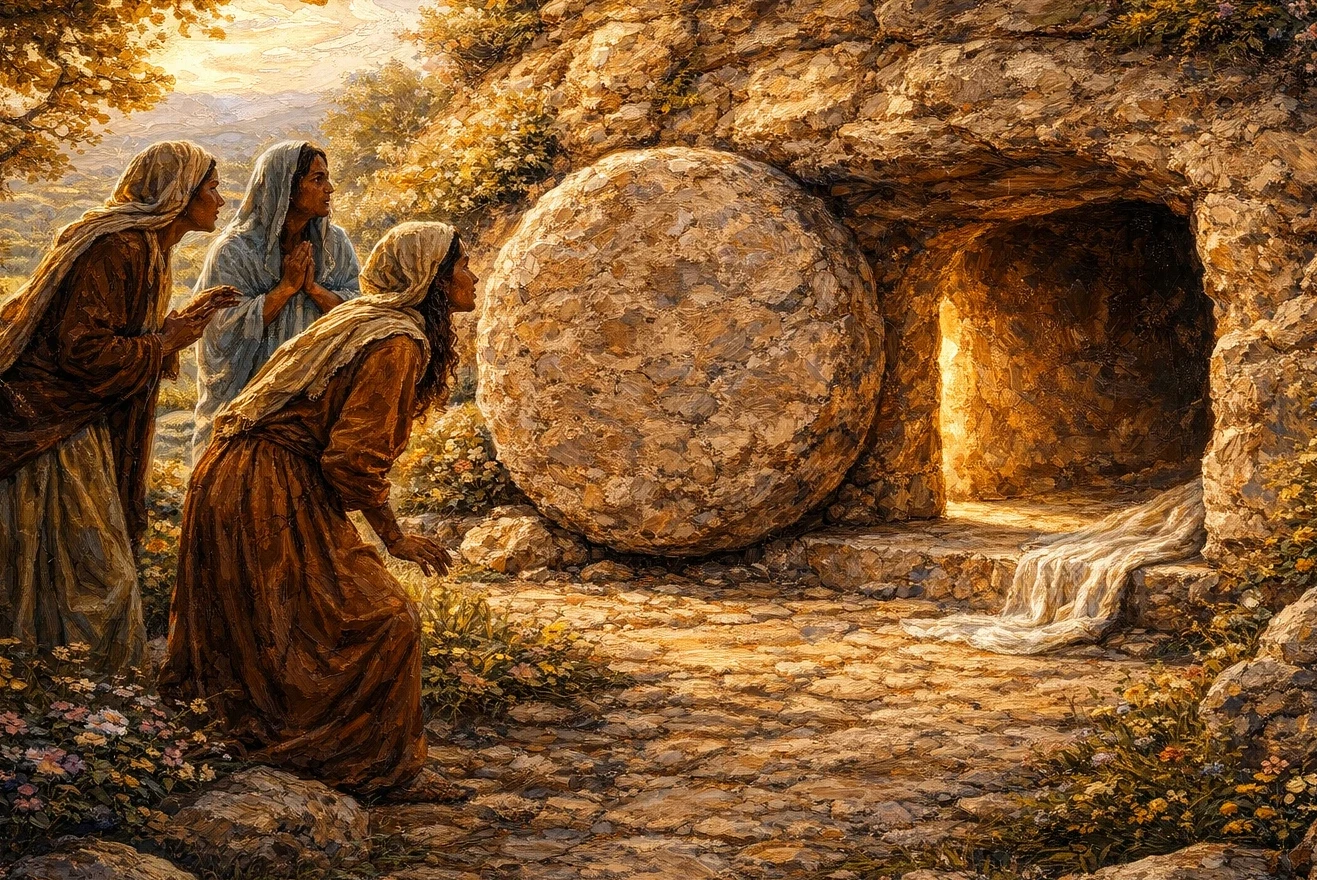
At dawn, several women approached the burial site carrying spices. Their purpose was simple: finish the burial rites interrupted by the Sabbath. They were not going to see whether He had risen. They were going to mourn properly. What they found instead became one of the strangest features of the story — strange not because of what happened, but because of who discovered it. They found the stone moved. And the tomb empty.
Women Were The First Witnesses
In the ancient world, women were rarely treated as reliable legal witnesses. In both Jewish and Roman contexts, male testimony carried greater authority. If someone in the first century were inventing a story meant to persuade others, the last people they would choose as primary discoverers of history’s most important event would be women. Yet every Gospel records them as the first witnesses. That awkward detail has never been smoothed out, never replaced, never improved. It remains — precisely because it is what happened. They ran to tell the others. And the others did not believe them.
The Tomb Was Empty
Two facts quickly became central in the earliest Christian preaching: Jesus had been buried. The tomb was now empty. This was not proclaimed generations later in distant lands. It was announced immediately in Jerusalem — the very city where He had been executed. If the body remained in the grave, Christianity would have ended that week. Authorities had motive to stop the movement early. Producing the body would have sufficed. Yet no record exists of anyone ever doing so. Instead, an explanation circulated among opponents: the disciples stole the body. But that explanation admits something crucial — the tomb was indeed empty. The debate was never over whether it was empty. The debate was how.
The Message Circulated
Within only a few years, a short statement circulated among believers wherever they gathered. It was memorized and repeated: Christ died for our sins. He was buried. He was raised on the third day. He appeared to many witnesses. The apostle Paul later recorded this creed in a letter to the Corinthians (1 Corinthians 15:3–7), noting that he himself had received it earlier. Historians date its origin to within three to five years of the crucifixion — far too soon for myth to grow.
The Claim Immediately Appears
Legends require time, distance, and fading memory. Here, the claim of resurrection appears immediately, among people who could verify or refute it. Christianity did not slowly evolve into belief in a risen Jesus. It began with it.
The Word Spreads
Soon, reports multiplied — not dreams or vague spiritual impressions, but encounters described with physical detail. Mary Magdalene, weeping near the tomb, heard her name spoken and recognized Him. Two travelers walking a long road spoke with Him for hours before realizing who He was. A room of frightened disciples saw Him stand among them, showing the wounds in His hands and side. One of them, Thomas, refused to believe unless he touched those wounds himself. He did — and answered with a confession no Jew would casually make: “My Lord and my God.” Later, Paul recorded that more than five hundred people saw Him at one time — many still alive when he wrote, inviting verification.
Encountering The Risen Christ
Hallucinations do not appear to groups simultaneously. They do not repeat across different locations and weeks. They do not convince skeptics and enemies. Yet among the witnesses was both. The Skeptic James, the brother of Jesus, had not followed Him during His ministry. The Gospels mention his doubt openly — another unflattering detail unlikely to be invented by early believers. Yet within a short time after the crucifixion, James became a leader of the Jerusalem church and was eventually executed for proclaiming Jesus as Lord. What changed his mind? Early Christian testimony consistently answered: he encountered the risen Christ.
The Conversion Of Saul
Then there was Saul of Tarsus. He viewed Christians as dangerous blasphemers corrupting Israel’s faith. He hunted them, approved arrests, and watched executions. Traveling to Damascus to continue his campaign, he later wrote that he encountered Jesus alive — not as memory or metaphor, but as a confrontation that shattered his certainty. He became Paul. The persecutor became the missionary. He lost status, endured imprisonment, beatings, and eventually death rather than deny what he said he saw. Psychology can explain many religious experiences. It struggles to explain an enemy willingly joining the side he tried to destroy and suffering for it the rest of his life.
They Saw Him Alive
Before the crucifixion, the disciples fled. Peter denied even knowing Jesus when questioned by a servant girl. They hid behind locked doors fearing arrest. Weeks later they stood publicly in Jerusalem — the city that executed Him — declaring He was alive and Lord of all. They did not gain power from this message. They gained persecution. Yet they persisted. Most of them were eventually killed for proclaiming the resurrection. People may die for beliefs they think are true, but a group does not willingly die for what they know they invented. If they stole the body, they knew it. If they hallucinated, they doubted it. Yet they died insisting they saw Him alive. Something had convinced them beyond fear.
The Movement Expanded
In the Roman world, messianic movements ended when their leader died. Followers dispersed. Another claimant arose later. But this movement did the opposite. It expanded. Within decades, communities of believers existed across the empire — in Jerusalem, Antioch, Corinth, Rome, and beyond. They came from different cultures, languages, and social classes, yet shared one central proclamation: Jesus is risen. They did not primarily preach His parables or moral teaching. They preached an event. The resurrection was not a later doctrine attached to Christianity. It was its foundation.
Alternative Suggestions
Over centuries, alternatives have been suggested. Perhaps the disciples stole the body — but then endured suffering and death for a lie they maintained to the end. Perhaps they hallucinated — but hallucinations are private experiences, not shared across crowds, locations, and time. Perhaps the wrong tomb was visited — but authorities could have corrected the mistake instantly. Perhaps legend developed — but the earliest testimony appears too soon, in the same place events occurred, among eyewitnesses. Each explanation addresses one detail but fails to explain them all together. The simplest explanation remains the most difficult one: The tomb was empty because Jesus rose.
He Lives
Something happened that first Sunday morning that transformed frightened followers into witnesses, skeptics into leaders, enemies into missionaries, and a failed movement into a global faith. Rome thought it had executed a man. Instead, it had ignited a proclamation. Not merely that He lived once… But that He lives still. And if that claim is true, then the story is no longer about what happened long ago. It is about who Jesus is now.